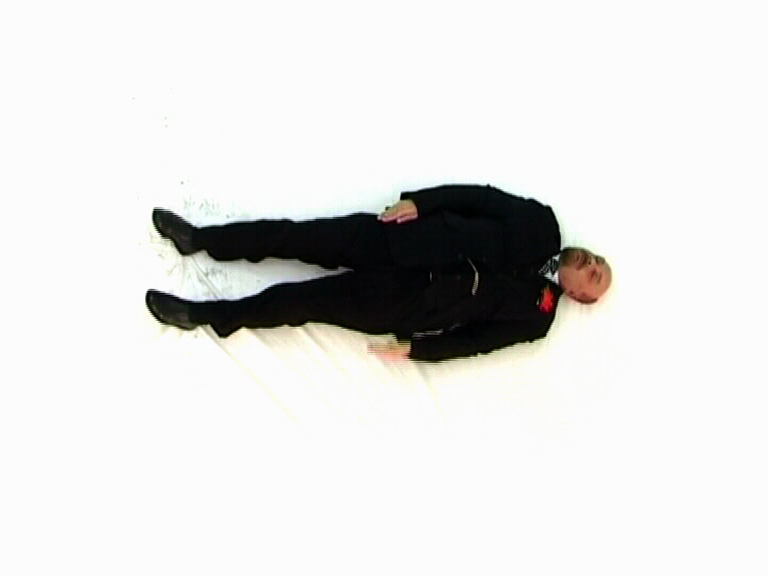
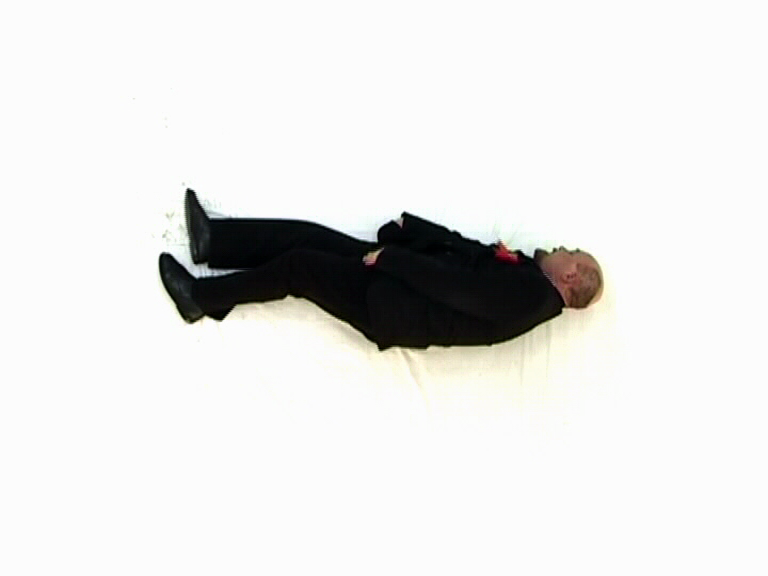
One of those emblematic works is the video installation Little People: looking into the simple cardboard boxes, one can see their life. Little people hold mass-meetings, fight each other, serve as cannon-fodder and fill mass graves with corpses.
In the box on view at the exhibition the leader of the world proletariat—Comrade Lenin—turns in his coffin with Albinoni‘s Adagio playing. In the case of Lenin turning in his grave, the situation is more than absurd: the father of communist Soviet Russia does not rest in a grave at all, but his embalmed body is on display in the Lenin Mausoleum on Moscow’s Red Square. If you will, Lenin’s body has been “turned into a museum piece”: it is on view and open to visitors in the heart of Moscow. By being put on public display, Lenin’s ummy embodies the Soviet state system, the immortality of the ideology, and its eternal validity—one might say that communism exists as long as Lenin’s body is visible. The common idiom “XY is turning in his grave!” we use when someone creates a version that deviates from its original, source, or ideal type—a bad or weaker version (dystopia instead of utopia). According to the artists, Lenin would be turning in his grave if he knew or saw what posterity has created under the banner of “socialism,” what has become of the great idea, while he himself (or more precisely, his mortal remains) is paraded as a kind of certainty, a spectacle, in the name of the materialist world view (Lenin’s family also opposed his placement in the mausoleum). In this respect, the artist duo Blue Noses appropriates the established forms of the modern museum and the secularised concept of immortality, rendering them ridiculous in their work. (KJ)