Do you have a favourite porcelain object that has broken? Are you familiar with the kintsugi technique? Have you ever wondered why we so often choose not to repair broken, damaged, or torn objects—or even relationships? Can you accept a broken porcelain piece whose cracks are not hidden, but instead highlighted?
During the workshop, participants will practice the technique of bonding with gold (kintsugi) on an object they bring from home. Please bring along one of your own broken ceramic objects.
IMPORTANT: Participants are kindly asked to bring a broken porcelain object to the workshop!
“Ceramics—and especially perfectly white porcelain, much like glass—are extremely hard and durable materials, yet at the same time fragile and brittle. This makes it almost inevitable that, through everyday use, not all pieces remain intact, and broken items are simply discarded. However, it is deeply painful when a favourite mug, a cherished unique cup, or an object received as a gift from a loved one falls victim to daily life or an unfortunate movement. I never part with a single broken ceramic piece. Depending on my emotional attachment to the object, I either break it further and turn it into a ceramic mosaic, or I give it a new life by applying the kintsugi technique. In the latter case, the cherished object is preserved, but its function is transformed, and thanks to gold, it reappears with a higher level of aesthetic value.” — Dominika Pálinkás
What is kintsugi?
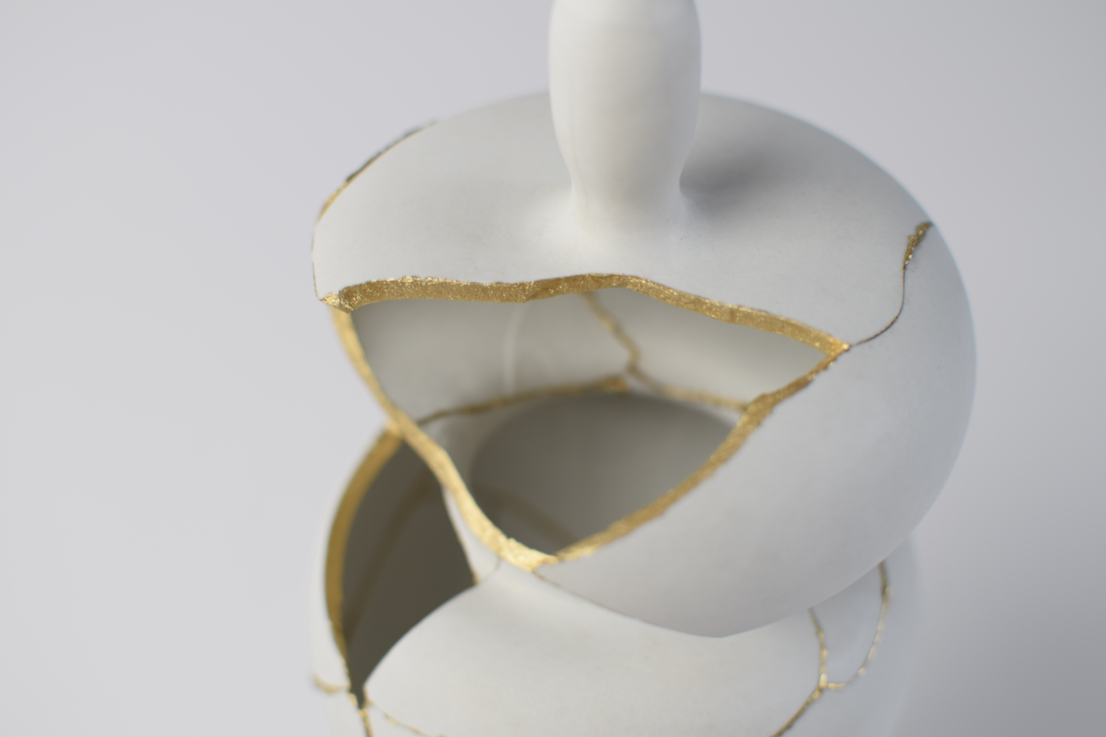
The kintsugi technique originated in 15th-century Japan and was developed to restore broken ceramic objects. The fragments were bonded together using lacquer mixed with precious metal powder—most commonly gold, but also silver or platinum—giving the object a new life and a unique, unrepeatable character. The gold visible on the surface highlights the cracks and increases the object’s value. This philosophy is rooted in wabi-sabi, which emphasizes imperfection, individuality, and the transience of human life.
Maximum number of participants: 12 (Participation is recommended for ages 14 and above.)
Workshop duration: 3 hours
Introduction to the world of kintsugi (30 minutes)
Exploring related works in the exhibition Golden Repair – Fine Adjustments (30 minutes)
Creative practice (2 hours)
Dominika Pálinkás – ceramic designer
Dominika Pálinkás studied ceramics in secondary school, then continued her education at the Department of Ceramics at the Faculty of Arts, University of Pécs. After obtaining her master’s degree, she completed a teacher training program in design and visual arts and began teaching at the Gandhi High School in Pécs. In parallel, she earned a bachelor’s degree in Behaviour Analysis at the Faculty of Humanities, University of Pécs. She later began teaching at the Ceramics Specialization of the University of Pécs. She is currently a doctoral candidate; her research focuses on the transparency of porcelain within porcelain sculpture.
For her, ceramics, pedagogy, and psychology form a unified triad, where these fields exist in close connection and dynamic interaction with one another.
Image: Diploma work by Lee Tanguchi, graduate of the Ceramics Specialization MA program, Faculty of Arts, University of Pécs
Tájékoztatjuk, hogy eseményeinkről hang- és képfelvétel készül, amelyből a Ludwig Múzeum részleteket használhat fel a múzeum és programjainak népszerűsítése céljából és egyéb promóciós célokra. Eseményeinken történő részvétellel Ön elfogadja, hogy a felvételeken Ön is feltűnhet, de a Ludwig Múzeummal vagy az általa jogosított harmadik személyekkel szemben a felvétel felhasználásával összefüggésben semmilyen követeléssel nem élhet.
Related content
Golden Repair 9. October, 2025 – 8. March, 2026
The exhibition Golden Repair is a continuation of a long-term curatorial venture that began in 2023 with the exhibition Handle with Care. It explores the themes of healing and repair in a broad sense, including social, natural, ecological, physical and psychological processes.
