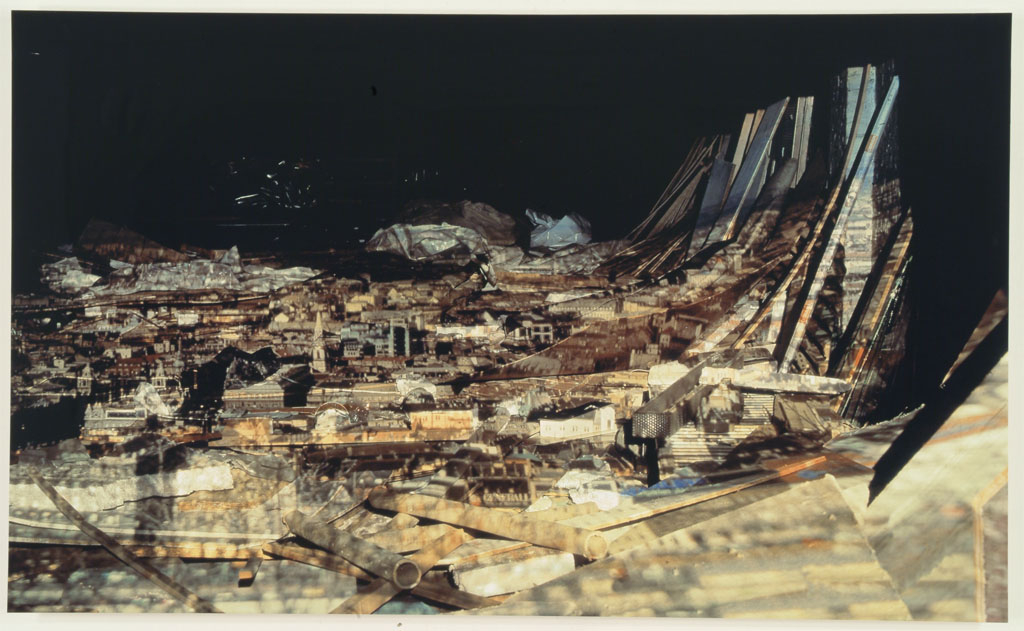
When approximately 30 years ago, Szacsva y Pál began producing his photographic series Reprojection, the works struck viewers with their conceptualism and striking execution. Large-scale, staged photography entered the Hungarian art scene in the early to mid 1990s and besides producing a substantial and impressive body of work, it also facilitated the introduction of the discourse of representation into Hungarian art theory. For the generation of young artists emerging from art school around the time of the political transition, photography offered an effective means of articulating new ideas and provided them with new modes of producing art within the shifting political, social, and artistic conditions. The process underlying the Reprojection series is relatively straightforward. Szacsva y used his own photographs, mostly depicting banal scenes and mundane objects, and projected them with a slide projector onto various found surfaces in darkened interiors: a pile of clothes at home, an attic with scrap materials at a res idency programme, and other similar environments. This method produced what Freud called the ‘uncanny’: images in which it often becomes difficult to distinguish between the layers or to determine their individual sources. In certain cases, the combination of these seemingly neutral layers unexpectedly yielded socially critical meanings. Although such content may not always have been the artist’s primary intention, it emerged through chance encounters between the projected images and the material surfaces. Since its creation in 2002, the interpretative possibilities of Reprojection XXXIV have shifted significantly. The work appears to have lost its initial art historical and theoretical context, gaining instead new layers of meaning. The way in which the image disorients the viewers by the sudden and unexpected switches between scales, generates a sense of unease that extends beyond the image itself. Today, having been exposed to an overwhelming number of images of catastrophe, war, destruction, and the materialization of negative scenarios, all are instantly and incessantly disseminated through social media, it becomes nearly impossible not to associate Reprojection XIII and XXXIV with the spectre of future disasters, new conflicts, and further ruptures. It is as if the unfolding of a negative utopia appears increasingly difficult to avoid. (TK)
Related content
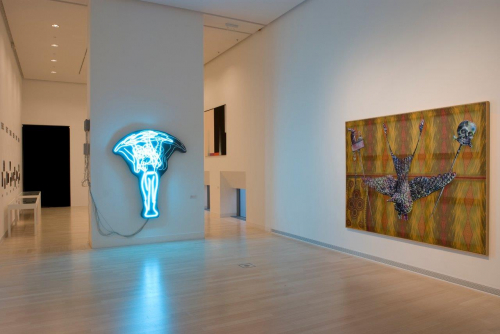
LUDWIG 25 - A kortárs gyűjtemény 13. November, 2014 – 25. September, 2016
LUDWIG 25. The Contemporary Collection
The new permanent exhibition of the Ludwig Museum – Museum of Contemporary Art