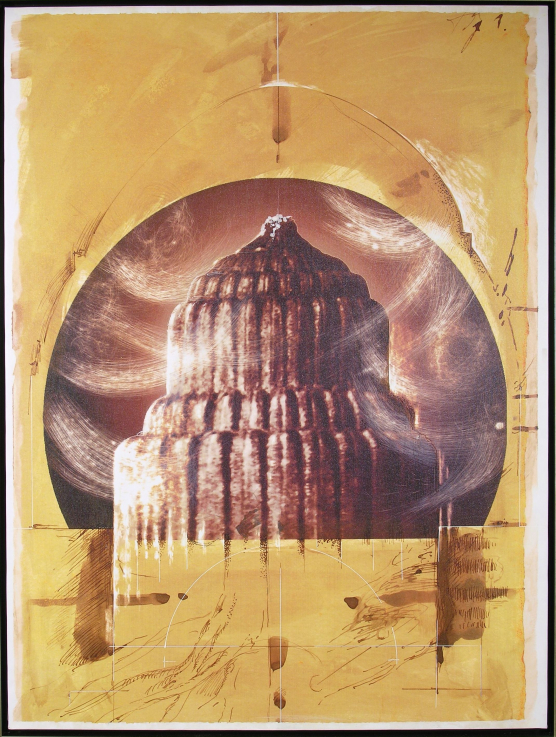
The central project of István B. Gellér’s oeuvre, developed over many decades beginning in the early 1970s, is “The Growing City”, which can be interpreted as a reconstruction of a fictional yet intricately elaborated civilisation. The work is not a single piece but a self-referential system, a network of interconnected objects, models, drawings, texts, and pseudo-documents that creates the memory of an imaginary culture. The project’s fundamental gesture lies at the intersection of archaeology and art. B. Gellér does not excavate an existing past, but creates the ruins of a “could have-been” civilisation (fictional archaeology), as if they were the remnants of a lost world. The fictional researchers, excavation notes, and seemingly scientific descriptions associated with the works construct an alternative knowledge sys tem in which document and imagination merge. “The Growing City” is not a static structure, but a constantly expanding, spirally organised system whose development proceeds according to its own internal laws. The model of the city simultaneously refers to archaic cultures and an imagined future: it is built upon the convergence of geometric and organic elements, while being imbued with layers of mythological and cosmological meaning. In the pro ject’s world view, space is not merely a physical expanse, but a symbolic system in which life, destruction, and transcendent forces intertwine. One of the key concepts of the works is fragmentation. The city is never shown in its entirety, but is revealed in the form of artifacts, fragments, and reconstructions. This absence functions not as a loss, but as a force that generates meaning: the viewer is compelled to fill in the missing parts imaginatively. With this method, B. Gellér also examines the nature of historical knowledge, pointing out that every construction of the past is a narrative and interpretive act. “The Growing City” can be viewed both as a visual mythology and a critical reflection on the fragmented experience of modernity. The architectural forms, sacred objects, and textual fragments presented in the project depict an image of a culture that carries the promise of totality, while remaining accessible only in fragments. In this sense, Bruno Gellér’s work is not merely the story of an imaginary city, but also a metaphor for contemporary cultural experience: a world in which the whole becomes conceivable only through its parts. (KJ)