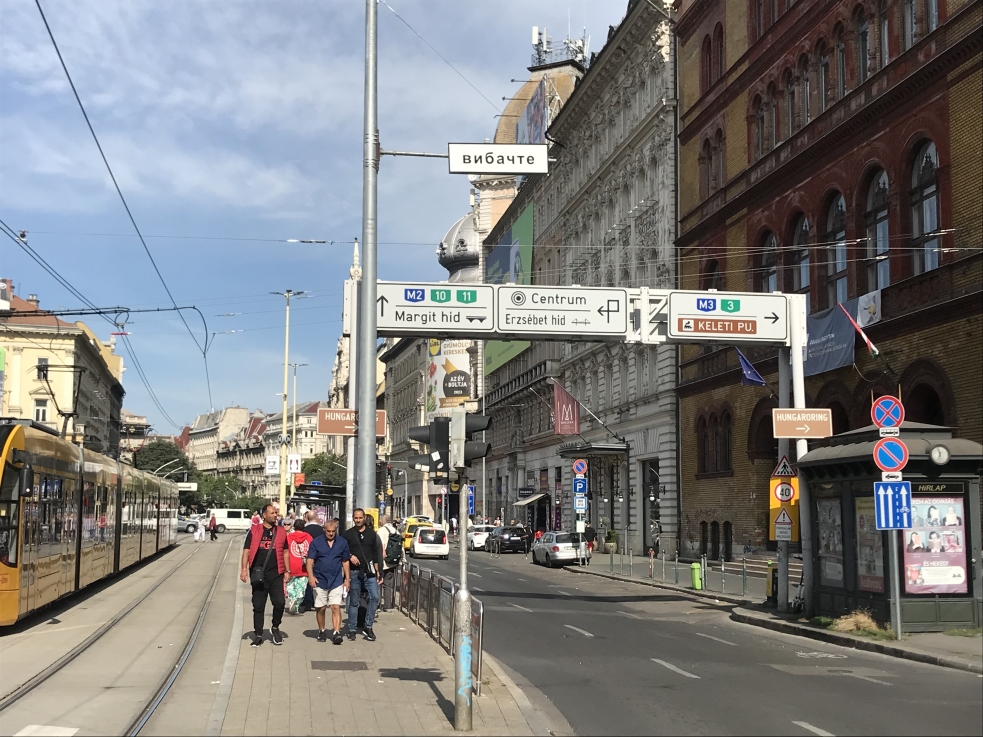
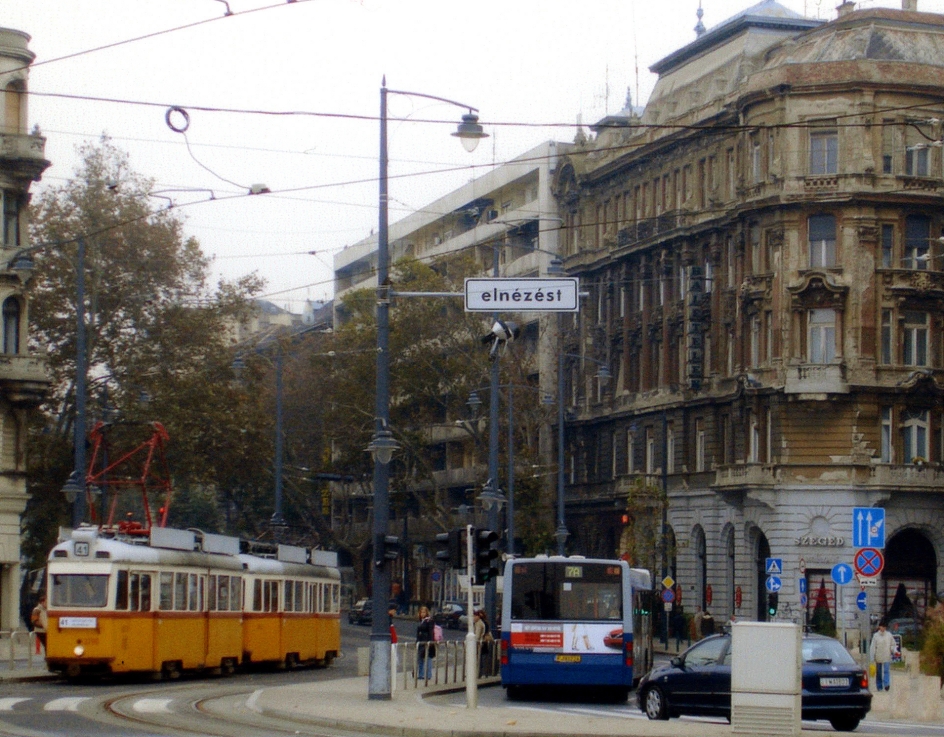
“My work is a pair of ordinary aluminium shields, 60 cm x 200 cm, mounted on a lamppost high above the traffic, like an usual sign, giving directions to the drivers showing for example the way to a certain city. But the text is saying sorry. I made earlier hungarian versions, later bilingual ones: Slovakian – Hungarian, Romanian – Hungarian, (both were exhibited in both countries), Roma – Hungarian one, and recently a Ukranian – Hungarian one in Budapest.
While this utterly simple and ordinary way of apologizing is an everyday occurrence in Japan, the expression, for instance, is used only a third as much frequently in Germany than in Japan. No similar investigations have been made in Hungary, but based on my personal experience, I think I am right to suppose that apologizing happens rather rarely in this country, in private and public spheres alike. Thus, it is by no means an everyday routine, even though we presumably have roughly as much reason to say sorry to our fellow citizens as people in Japan. Probably we would feel more at ease, both in our private lives as in the public sphere, if we practised this gesture, i.e., admitting our mistakes, faults, ignorance, foolishness, selfishness, stupidity or intolerance, and voicing our regret more frequently for any misunderstanding, confusion, offence or exposure that such an act may have led to - right here and now. Not to mention that we tend to counterbalance our bad conscience about our failure to say sorry with aggression, self-conceit and intolerance - again both in our private and public lives. This is why I think that in the chaos of urban visuality, amidst the deluge of advertisements, signposts, graffiti and billboards, such a consciously simple piece could have a strong effect. The first question it raises is who might be the person who wants to apologize here and now, and for what and to whom? The very task of interpretation may take the viewer on more distant routes, since one has to admit that SORRY according to her/his current disposition. Shields with Hungarian text (elnézést) were realized six times between 2004 és 2008. From 2009 on beside the Hungarian text the sorry can be read in an other language too. The bilingual versions were:
2009 Sept. Romanian - Hungarian version, Târgu Mureș, Romania 2009 Oct. Slovakian - Hungarian version, Dunaújváros, Hungary 2009 Dec. Slovakian - Hungarian version, Bratislava, Slovakia 2010 Apr. Romanian - Hungarian version, Budapest, Hungary 2010 Aug. Roma - Hungarian version, Pécs, Hungary 2013 Sept. Slovenian - German version, at the Austrian – Slovenian border 2022 April Roma – Hungarian version, Budapest 2023 Sept. Ukranian – Hungarian version, Budapest” János Sugár